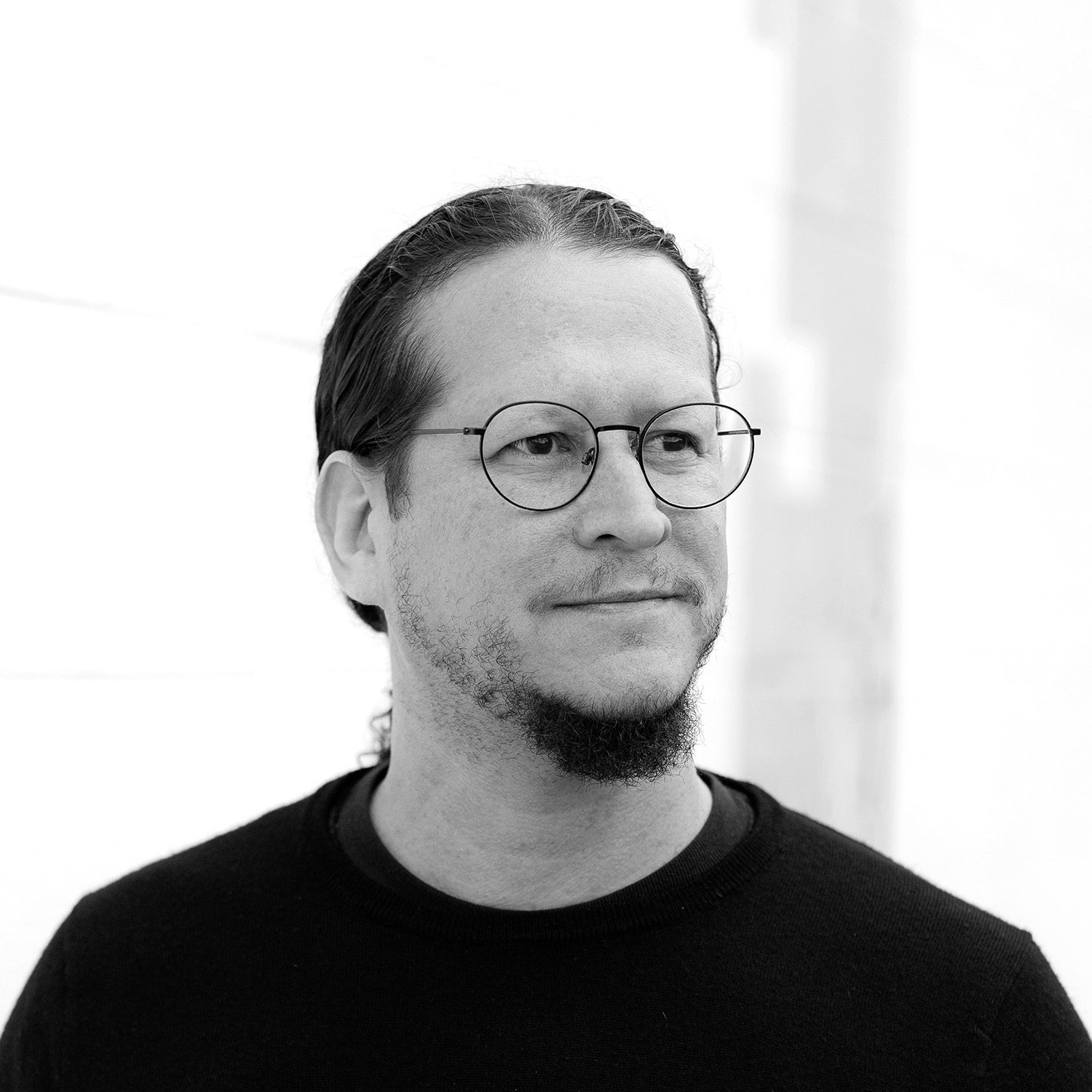
We spoke with artist Ivan Toth Depeña about his background and the process behind his new work Sound/s at Symphony Block. Read on to learn more!
With over 20 years of experience and education in fine art, architecture and design, Ivan’s projects focus on the fusion of the aforementioned disciplines with technology and science. His work consists of various media ranging from hand drawing to high-tech, interactive light installations. His tools are developed through the investigation of different methodologies, often incorporating a synthesis of traditional techniques with technological advances. Ivan’s process evolves from an initial idea that develops via research, exploration, the interplay of materials, construction, composition, light and color, and how these elements can be layered to resonate with senses, emotion, and perception.
What is your background in the arts? Tell us more about your practice and connection to the art community in Seattle.
I have studied art starting at arts magnet schools since I was in 8th grade. My practice is rooted at the intersections of fine art, public art, architecture, technological innovation and design. I have been working for more than 20 years creating site-specific artworks. My background in architecture strongly informs how I think about scale, site, movement, material, and the way people encounter artwork in the built environment.
My work involves translating invisible or intangible forces into physical and visual form. I have created works informed by wind, light, environmental data, movement, memory, and sound. I am interested in how art can make people more aware of their surroundings and create a stronger emotional connection to a place.
My connection to Seattle for this project is through the site, the Symphony, the City, and the broader civic context of public art. Because the artwork is located on the Benaroya Symphony Parking Garage, I approached the project not simply as a façade treatment, but as an opportunity to create a public-facing extension of the musical and cultural life of the Symphony. The work is meant to contribute to Seattle’s public art landscape while responding directly to the identity of this specific place.
What inspired Sound/s? Besides the location, does the design have any connections to the Symphony?
Sound/s was inspired by the idea of making music visible. The garage façade is situated in direct visual relationship to Benaroya Hall, so I wanted the artwork to feel connected to the energy of performance, rhythm, and collective listening, even though it exists outside in the city.
The design is directly connected to the Symphony through the use of audio as source material. The vertical forms are parametrically derived from RE|Member by Reena Esmail, who was Seattle Symphony’s 2021 Artist in Residence. That audio became a kind of sculptural score. Frequencies, amplitudes, and rhythmic qualities from the music were translated into the placement, density, height, and movement of the vertical elements.
The result is not a literal illustration of a song, but a physical interpretation of musical structure. The artwork becomes a visual echo of the Symphony: layered, dynamic, and experienced differently depending on distance, angle, light, and movement through the city.

How was the community involved or taken into consideration in your process?
The community was considered through the site, the Symphony partnership, the public nature of the façade, and the way people move through downtown Seattle. This is not an artwork that only serves one type of viewer. It will be seen by concertgoers, residents, workers, visitors, pedestrians, transit riders, and people passing through the surrounding streets every day. We created an early online survey regarding what elements could possibly augment the concept and took into consideration community feedback.
Choosing the audio source in collaboration with the Seattle Symphony was an important part of grounding the work in the cultural life of the site. Reena Esmail’s RE|Member brought a meaningful connection to the Symphony’s programming and contemporary musical community, rather than treating the building as a generic backdrop.
The design also considers accessibility at the level of experience. A viewer does not need to understand the parametric process to respond to the work. From a distance, it reads as energy, rhythm, color, and movement. Up close, people can begin to understand that the forms are organized by sound and that the facade is acting almost like a visual score.
Have you talked with Future Arts about their AR artwork related to Sound/s? How will the two works tie together?
We understand Future Arts’ AR component as an opportunity to extend the experience of Sound/s beyond the physical sculpture. The sculpture itself translates sound into form, color, density, and rhythm on the façade. The AR artwork can build on that same idea by adding another interpretive layer. Potentially reintroducing sound, movement, narrative, or interactive digital content back into the viewer’s experience. Future Arts has incorporated particular flower species that have a direct relationship to each of the artist’s installations that they are working with.
The strongest connection between the two works is the shared concept of translation: music becoming visual, physical, spatial, and potentially digital. The physical sculpture anchors the experience in the architecture and street, while the AR component can give visitors another way to engage with the source material, the Symphony connection, and the idea of sound as something that can be seen, felt, and explored.
Sound/s creates the permanent physical presence. The AR layer can deepen the public’s understanding of how the piece was generated and create an additional point of access for residents and visitors.
What do you hope residents and visitors interacting with your work will experience?
I hope residents and visitors experience the work as a moment of discovery in the city. From a distance, I want it to operate as a vibrant landmark that brings energy and identity to the façade. As people move closer, I hope they begin to sense rhythm, layering, and variation, almost as if the building is holding a piece of music in physical form.
The goal is for the artwork to create a bridge between the Symphony and the public realm. Not everyone passing by may be attending a performance, but the artwork allows them to encounter the spirit of the Symphony from the street. It makes the musical identity of the site visible and accessible.
I also hope the work invites curiosity. Someone might first respond to the color and scale, then later learn that the forms were generated from music. That shift from visual experience to conceptual understanding is important to my work. Ideally, Sound/s becomes both an immediate sensory experience and a deeper reflection on how music, architecture, community, and public space can come together.
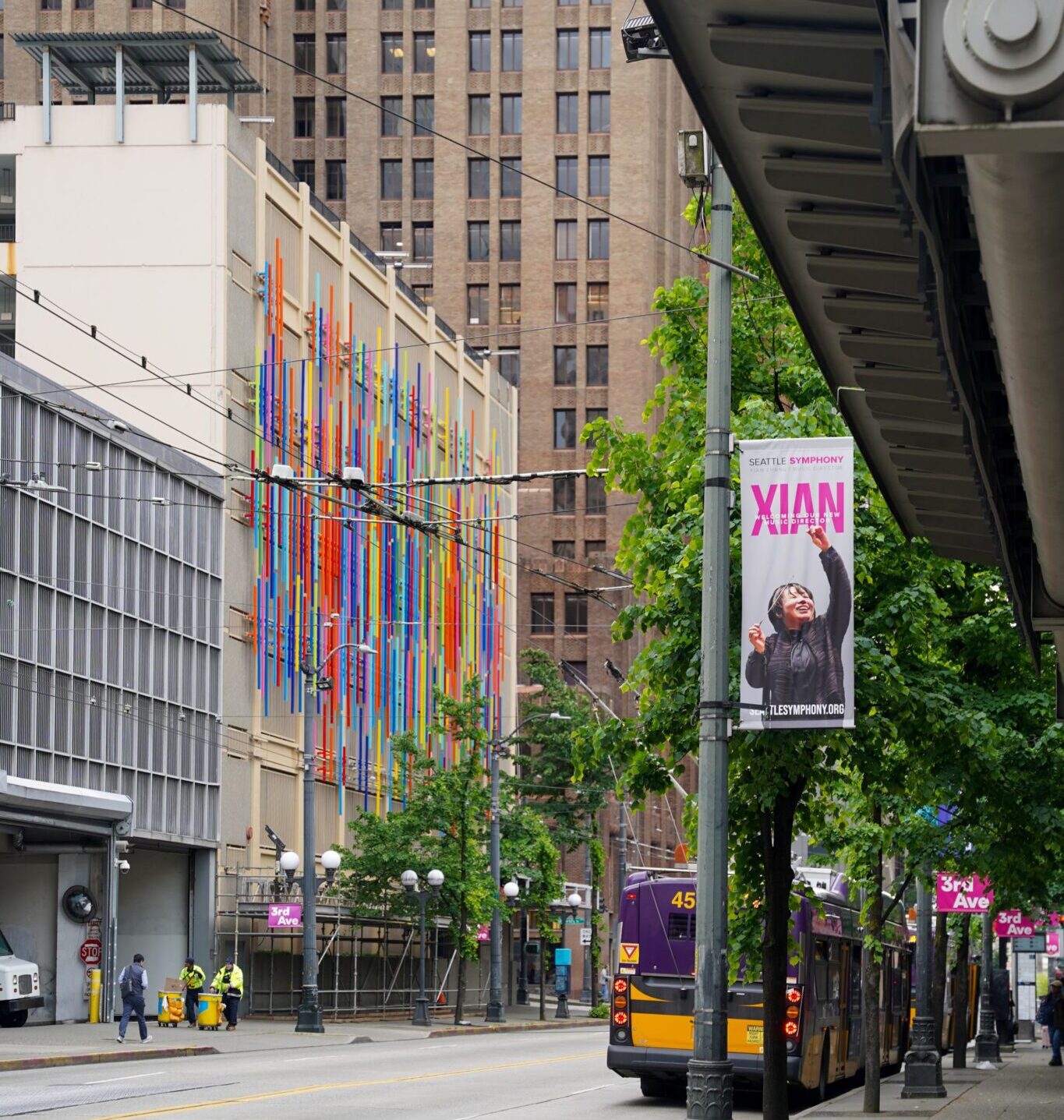
The Symphony Block temporary public art installations are in partnership with Seattle Department of Transportation, Seattle Symphony, Benaroya Hall, King County Metro, Sound Transit, Downtown Seattle Association, Unico Property Management, and the University of Washington.