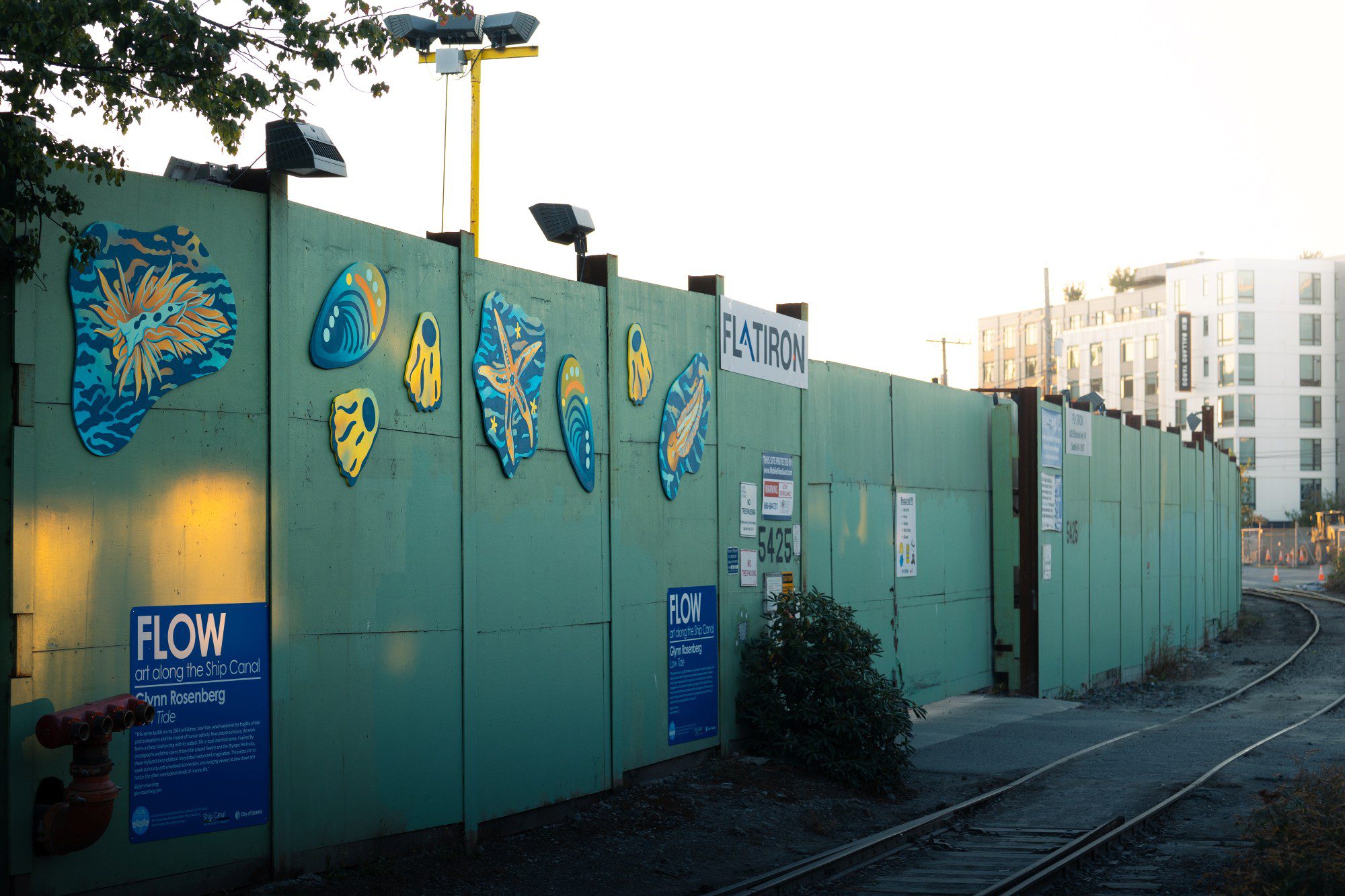
 "Low Tide" by Glynn Rosenberg. Photo by Blooming Pixel.
 As you make your way up Shilshole Ave toward NW Market Street in Ballard, vibrant aquatic forms now ripple across the urban landscape. Low Tide, the temporary public art by artist Glynn Rosenberg, builds on their 2024 exhibition of the same name. The piece explores the delicate balance of tide pool ecosystems and the impact of human activity on marine life. Installed outdoors, Low Tide finds itself in direct dialogue with its subject matter, the intertidal zones that hug our local shorelines.
Rosenberg’s work draws inspiration from observing the life that thrives at low tide around Seattle and the Olympic Peninsula. Through a blend of observation and imagination, Rosenberg transforms these moments into stylized, almost dreamlike portraits of the Pacific Northwest’s marine world. The result is a vivid celebration of life that exists between land and sea.
See the work for yourself at 5425 Shilshole Ave NW. You might find yourself noticing the shimmer of tide pools, the rhythm of the water, or the small, resilient creatures that make this place so alive.
A Conversation with the Artist
We spoke artist Glynn Rosenberg about the ideas behind Low Tide and their participation in FLOW, the ongoing public art series connecting creativity with Seattle’s waterways.
The Ship Canal has a complex history — from industry to ecology. How did that layered history influence your installation or imagery?
The Ship Canal connects Lake Washington and the Puget Sound, making it one of the industrial projects that dramatically reshaped the geography of our region. The people who settled Seattle did a lot of that – reshaping the geography to accommodate their industry, without much thought about how changing the landscape might impact the rest of the ecosystem or the Indigenous People. The ecological balance is fragile, and I wanted my piece to highlight this.
The Ship Canal is interesting too, in the sense that it reshaped the connection between freshwater and saltwater, even changing the direction of rivers and turning a salt marsh into a body of freshwater. What happened to the animals in the salt marsh when it became Salmon Bay? I want the viewers of my installation to make the connection that the animals and plants in the intertidal zone are linked to the entire water system in our region, and that protecting these species requires managing the fragile ecological balance.
Many of your works carry a quiet sense of movement, like the natural rhythms of water or migration. How do you translate those dynamics into your visual language?
The wave-like patterns in the backgrounds of the sea star, nudibranch, and sea pen are inspired by the way that light reflects off water, so the patterns invoke a sense of water-like movement. My process of translating this movement starts with simplifying the shapes into their most essential parts. I like to take away complexity, so what’s left behind really captures the feeling of water without excessive rendering. The patterns do a lot of work to move the viewer’s eye throughout the painting, which can be interpreted as following the path of the intertidal species as they flow in and out with the tides.
Do you see your art as a form of environmental storytelling or advocacy? How do you hope people will think differently about the canal or its wildlife after seeing your work?
Yes, I do consider my work a type of environmental advocacy, though I think it has some limitations in that regard. What this project has the capacity to do is introduce people to animals that they may not realize we have in the Pacific Northwest, like the nudibranch. Not only do we have nudibranchs in Seattle, but you can see them at low tide, under the Fauntleroy Ferry Terminal in West Seattle.
My hope is that by using a large scale, viewers discover the strange and wonderful animals hiding on our shores and feel drawn to exploring tide pools on their own. I think this is part of the reason we have such strong advocacy for the orca whales in our region – people love them because they can have personal encounters with them. We care more when we know species on a personal level. I’m hoping that my work about the intertidal zones helps people create their own relationships with the different species, and from there, they can begin to advocate for the protection of these important ecosystems.
Are there artists, writers, or even scientific concepts that inform your creative vision?
When I started making my work about the intertidal zone, I was inspired by Karen Hackenberg. She is an artist based in Port Townsend who juxtaposes beautifully painted ocean landscapes with beach trash. By painting the trash with such care, she doesn’t allow the viewer to avoid thinking about the litter – it’s right in your face.
I was also inspired by Sabrina Imbler’s debut book of essays, How Far the Light Reaches, which pairs exploration of deep sea creatures with memoir-style stories. This book is particularly inspiring because of Imbler’s ability to connect the animals of the sea with the experience of being queer. It also reminds me of an article that was printed in The Stranger earlier this year called Poolin’ Around by Madison Kirkman. The article explores how queer people in the Seattle area are finding community while tide pooling.
All of these inspirational works focus on the ways that people connect through the animals and plants found in our seas. I especially love how Imbler feels inspired by the sense of wonder that the sea can invoke in people, and I feel similarly about my own work.
Low Tide was commissioned with Seattle Public Utilities 1% for Art funds, administered by the Seattle Office of Arts & Culture.