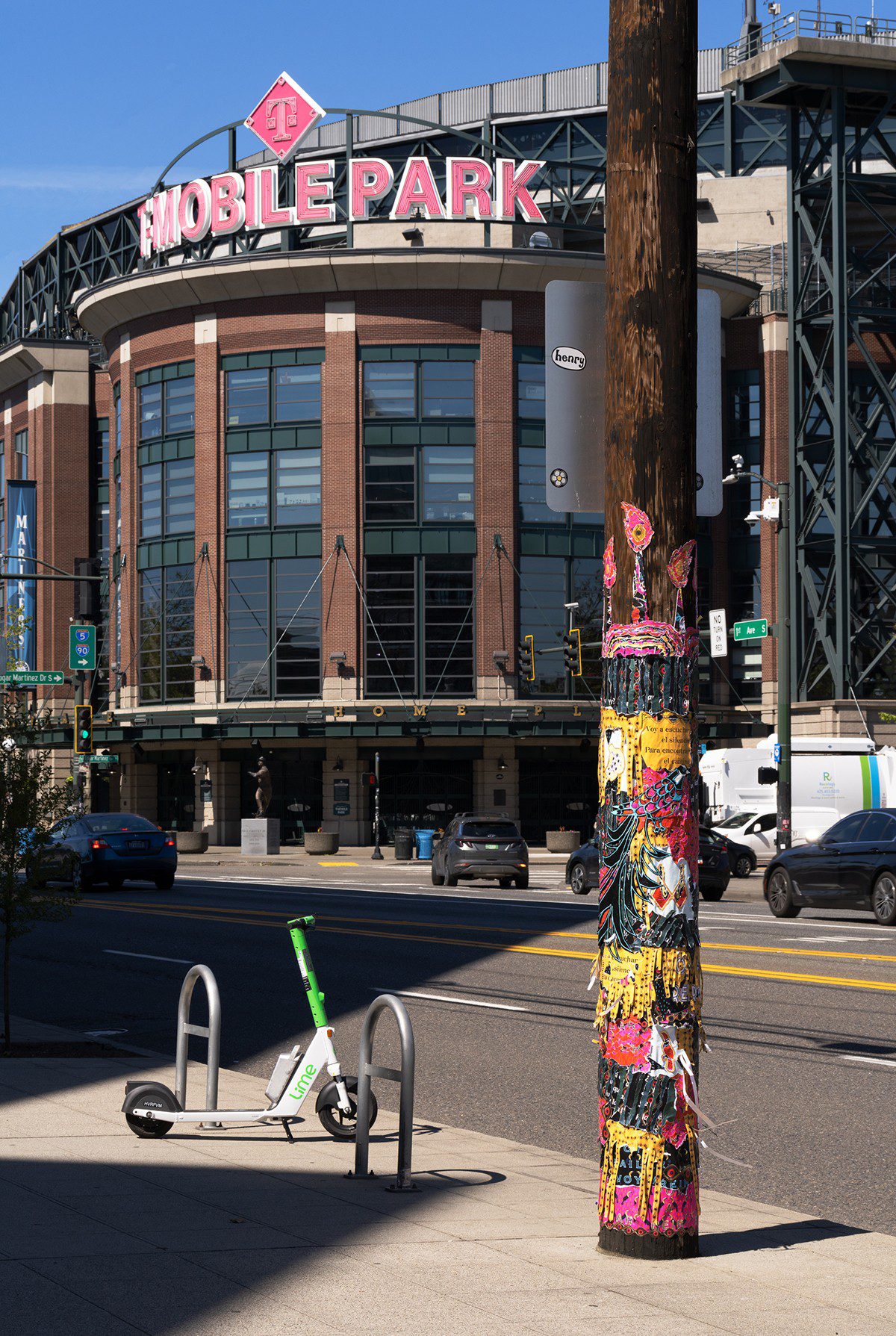
 Photo by Jueqian Fang.
 The brightly colored paper flowers, leaves, and posters that are blooming from the utility poles diagonally across from the South corner of T-Mobile Park (West side of First Ave between Atlantic and Massachusetts) are the work of Hope Corps grant recipient Diana Dvora Falchuk. Her practice moves across mediums to explore themes of belonging, rupture, resilience, and solidarity. From early interventions on utility poles to her long-standing commitment to arts-integrated social justice work, Diana’s art invites us to notice what persists, what transforms, and what binds us to one another.
Read on to learn more about her practice, how her Utility Pole Project continues to evolve, and how her new series, Somos lo que crece / We are what grows, activates public space through imagery, memory, and movement.
What is your background in the arts? Tell us more about your practice and connection to the art community here in Seattle.
My artistic practice is grounded in my ever-expanding collection of life-worn object fragments that I have been tending, transforming, and iterating for nearly 30 years. I integrate my collection with my and my family’s multi-diasporic Ashkenazi Jewish culture, spirituality, and languages (Poland, Venezuela, Germany, and the U.S) to generate works in a range of media that explore questions of interconnection, hereness/thereness, presence/longing, rupture/repair, and solidarity.
I’ve been making art my whole life and have a deep love for and connection to the Seattle arts community. I spent many years showing my work and organizing shows, including as a member of Crawl Space Gallery. I’ve also worked for many arts organizations, as an educator, teaching artist, and program director, and also as trainer and consultant for racial equity and relational leadership. At one point, I founded Arts Connect, a post release program for court-involved young people in Pierce County and helped start Creative Justice in King County. I served on the Seattle Arts Commission for 5 years until I got hired by the City’s Office for Civil Rights / Race and Social Justice Initiative and eventually led arts-integrated projects in partnership with the Office of Arts and Culture until I left the City in 2021.

Can you tell us about The Utility Pole Project and how Somos lo que crece / We are what grows fits into the project?
The Utility Pole Project, now in its 26th year, was the first art project I did as a young adult after moving to Seattle in 1999. At that time, the city was in the middle of a 10-year ban on putting up posters on the utility poles that lasted from 1994 – 2004. The weathering washed out poster bits and rusted staples – much like some of what you see on the center pole in our series here – captivated me. I was (and continue to be) drawn to the aesthetic and aliveness of anything aging and decaying. The old poster detritus reminded me of crumbling frescos and other old, devotional art. On a pole you might see remnants of a poster promoting a drag show or acoustic guitar lessons intermingled with a request for help finding a lost pet, offers for free therapy or HIV testing, or invitations to a dance performance, museum exhibit, or hip-hop show. They were like the spirit of the community past. I started going around the city, taking photographs of these accumulations and ripping off pieces for my personal collection of tiny, broken and imperfect object fragments.
I soon discovered City Light has a pole yard for “retired” poles where you could purchase segments of poles. I bought a few for something like $6 and $9 each and brought them to my studio. I used posters that I harvested from poles around the city and new ones that I made advertising fake utopian and dystopian events to construct reproductions of pop culture heroes, popular religious icons, and valentines.
I continued to document and make art on poles throughout the poster ban and after, when the layers of posters began to accumulate and get washed out or covered over once again. I made art on the poles during times of collective despair, such as during the 2023 US war on Iraq, and personal grief, such as following a romantic break-up. I wanted to give people something to reflect on that would inspire connection and resilience, as well as critique of political power.
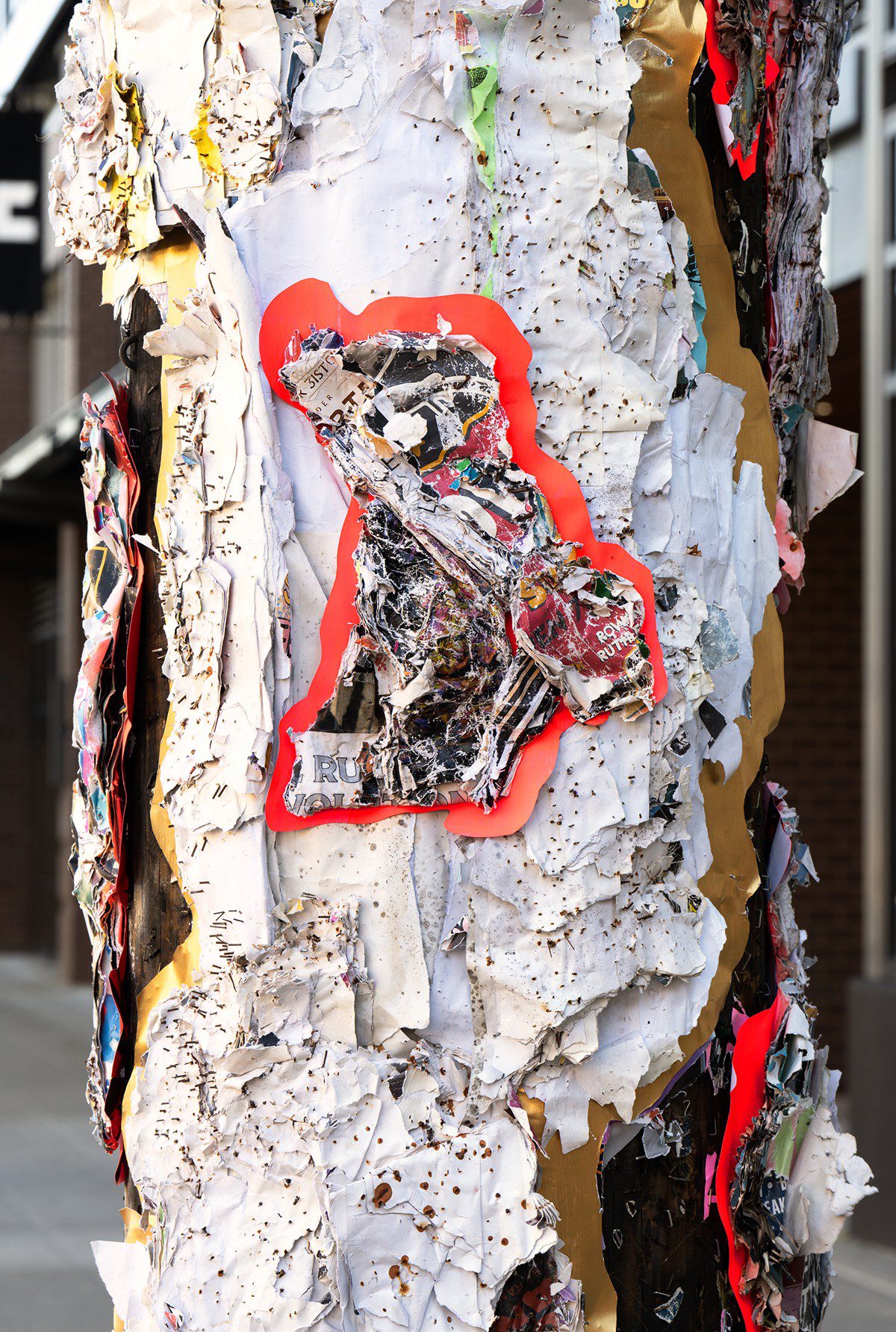
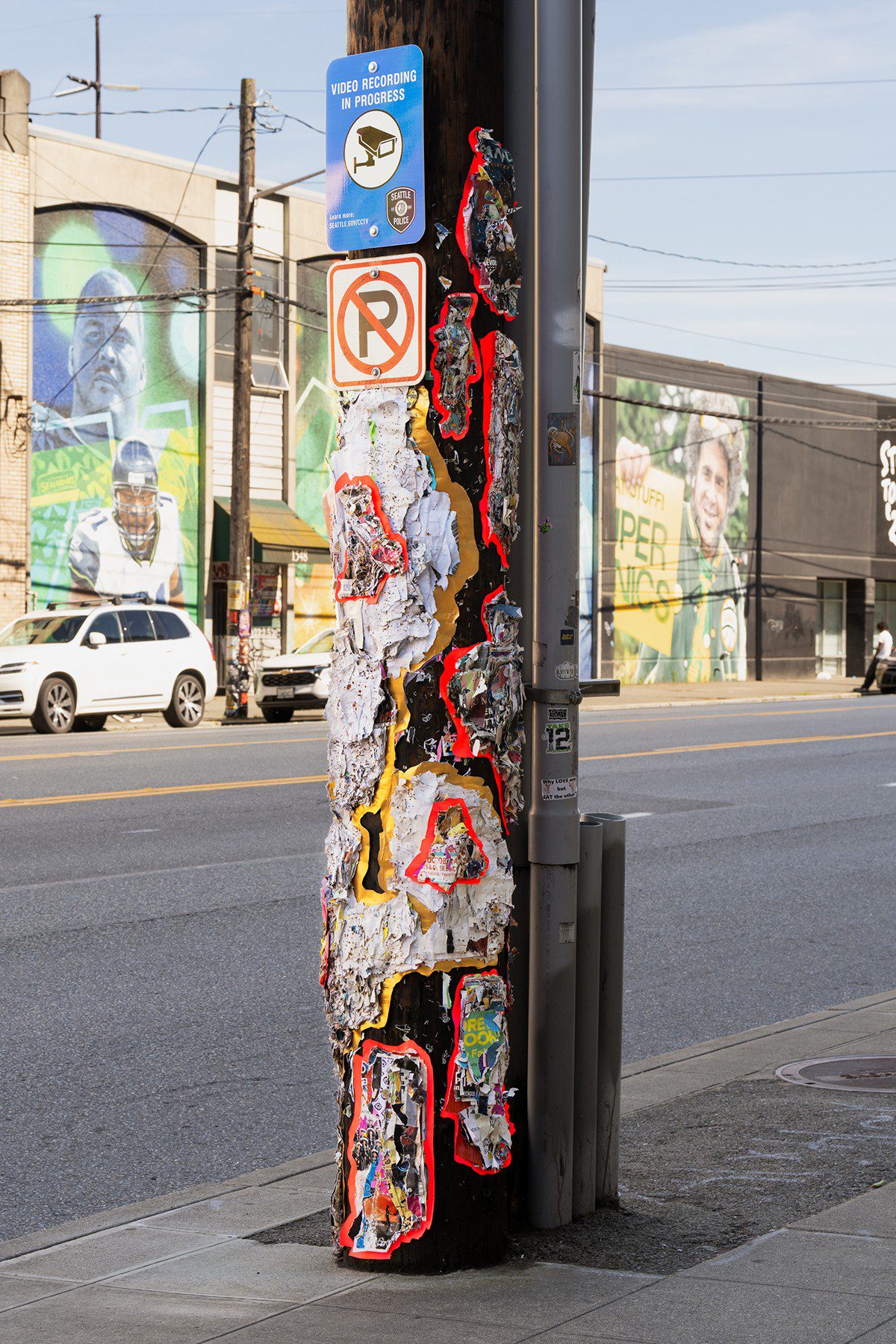
I love that the poles are sites for communication by and for the people: While much of the posters we see on poles throughout Seattle today are full color and glossy, having a lot of money to print posters isn’t a requirement. With free printing and copying at Seattle and King County libraries, pretty much anyone can make and place posters on poles to get their message out to pretty much anyone in whatever languages and with whatever images they choose. They are places where we can say things to the bigger we about what we believe matters and what we wish for each other.
I have been organizing for migrant justice for many years, in different ways. I had been thinking about a Utility Pole Project series that could speak to the anger I was feeling about the escalation in violence being directed at immigrants here in the U.S. and was feeling particularly angry at the ways Venezuelans and other Latine people were being maligned in the media and by the federal government. When I read the call for We Still Dream a Future, it seemed like a way, however small, to express immigrant resilience and vitality in the face of this institutional and structural violence.
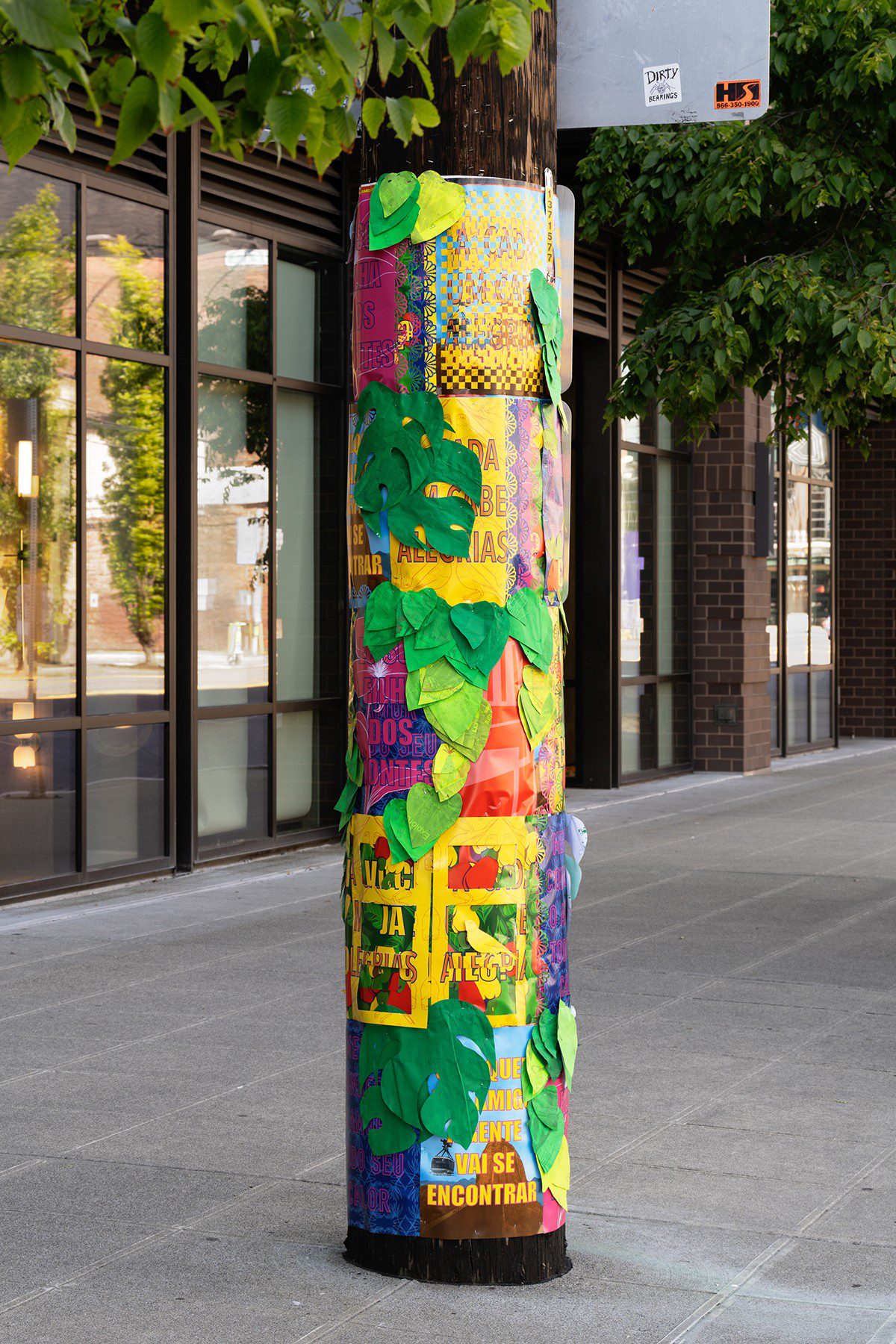
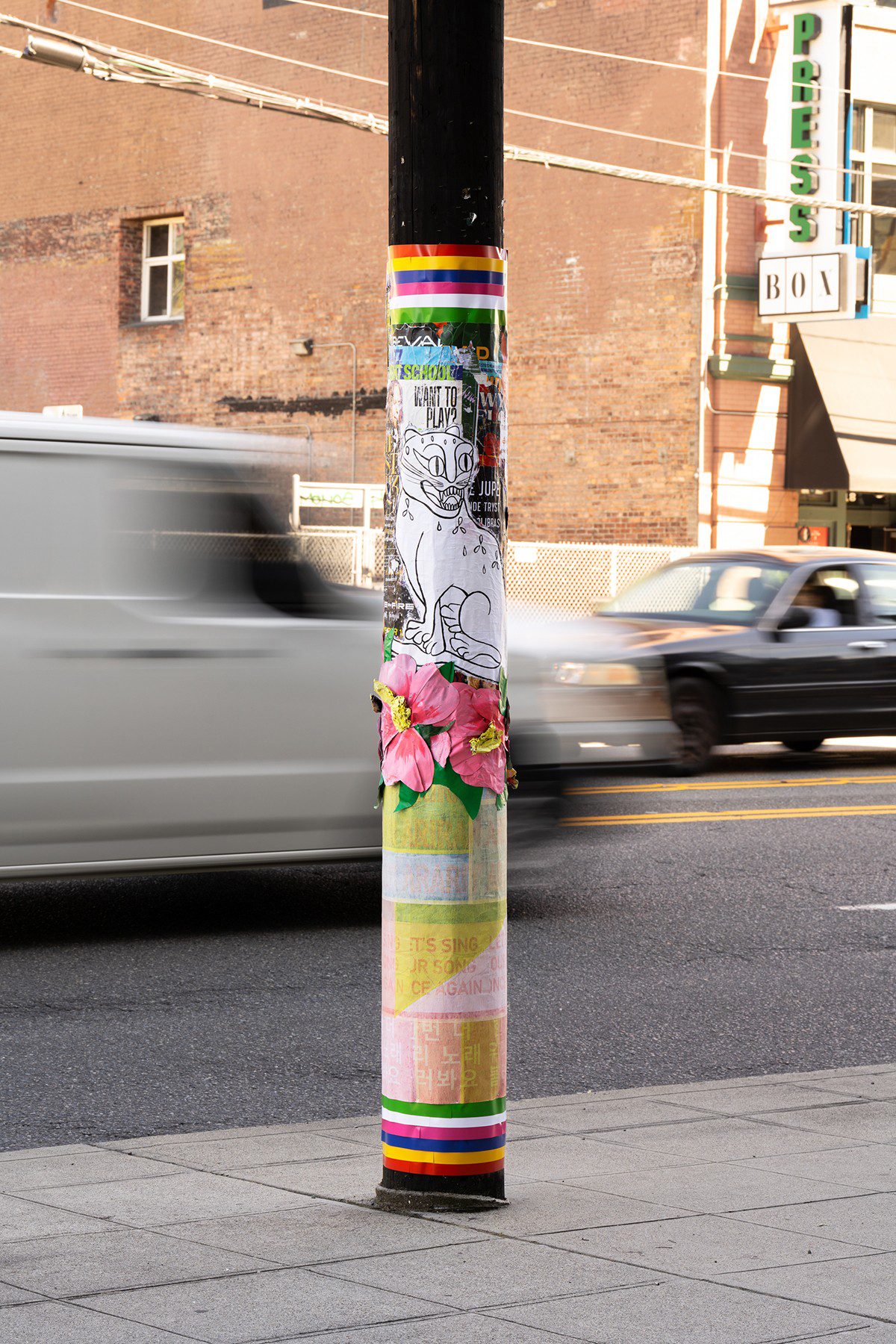
The poles were intended to represent some of Seattle’s immigrant communities via connections to members of our team. (For example, Venezuela, where my family is from, coincidentally has never played in the FIFA World Cup.) We chose the countries based on where the contributing artists on our project team and / or our families are from: Venezuela, Mexico, Brazil, and Korea. We collected and shared images of flowers, plants, art, clothing, other aspects of material culture, and places that make us think of our / our families’ homes and of belonging, resilience, and vitality. We also collected and shared lyrics to songs that evoke the same. The images and song lyrics are what Karen Woodburn and I used to draft the initial designs for each pole, for review by the team; we also incorporated the imagery and lyrics into the individual posters we designed, printed, and then used to create the imagery on the poles.
Since these works are site-responsive and installed on existing utility poles, were there any challenges or surprises you can tell us about when creating these works?
We measured and mapped the poles (like where there were signs that we needed to work around), which helped us arrive to install prepared for the site. I tend to work more emergently and really love getting into the materials, discovering what they have to teach me, and revising and recycling them. I really enjoyed the digital design phase, but the fact that we ended up waiting longer than planned to get the location approved meant we started the design phase a couple months later than anticipated. As a result, I ended up having less spaciousness in the fabrication phase to work and re-work with the actual materials. Life cycles and the ongoing transformation of material culture are strong currents in my work and the installations I show are often a step along a life course that includes multiple, prior iterations and future ones. So that was both an important affirmation for me as an artist and an important learning for future work. On the upside, I’ve had several dreams of what I might do with the materials from the poles I worked on once the installation comes down.
What do you hope residents and visitors interacting with your work will experience when encountering Somos lo que crece / We are what grows?
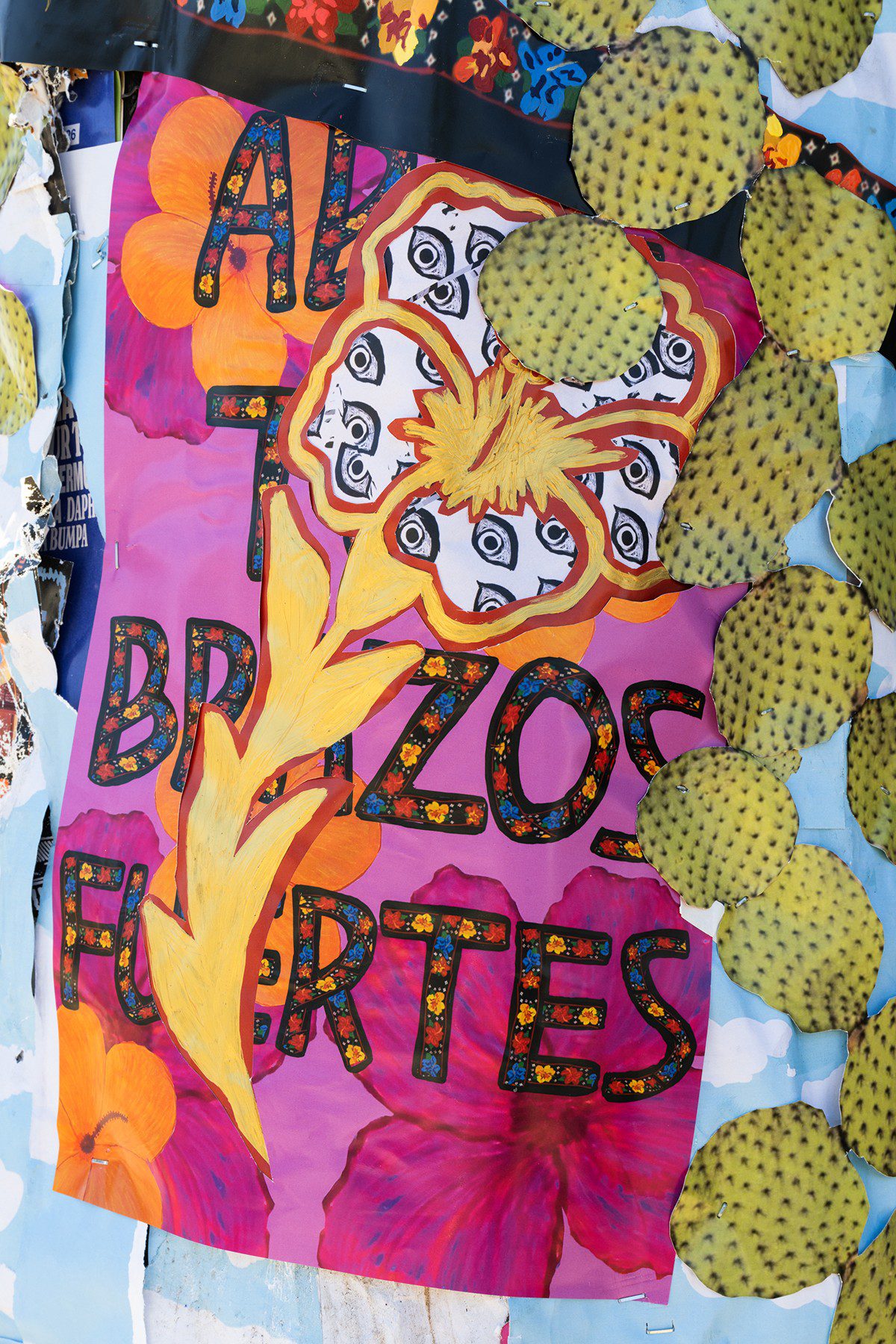
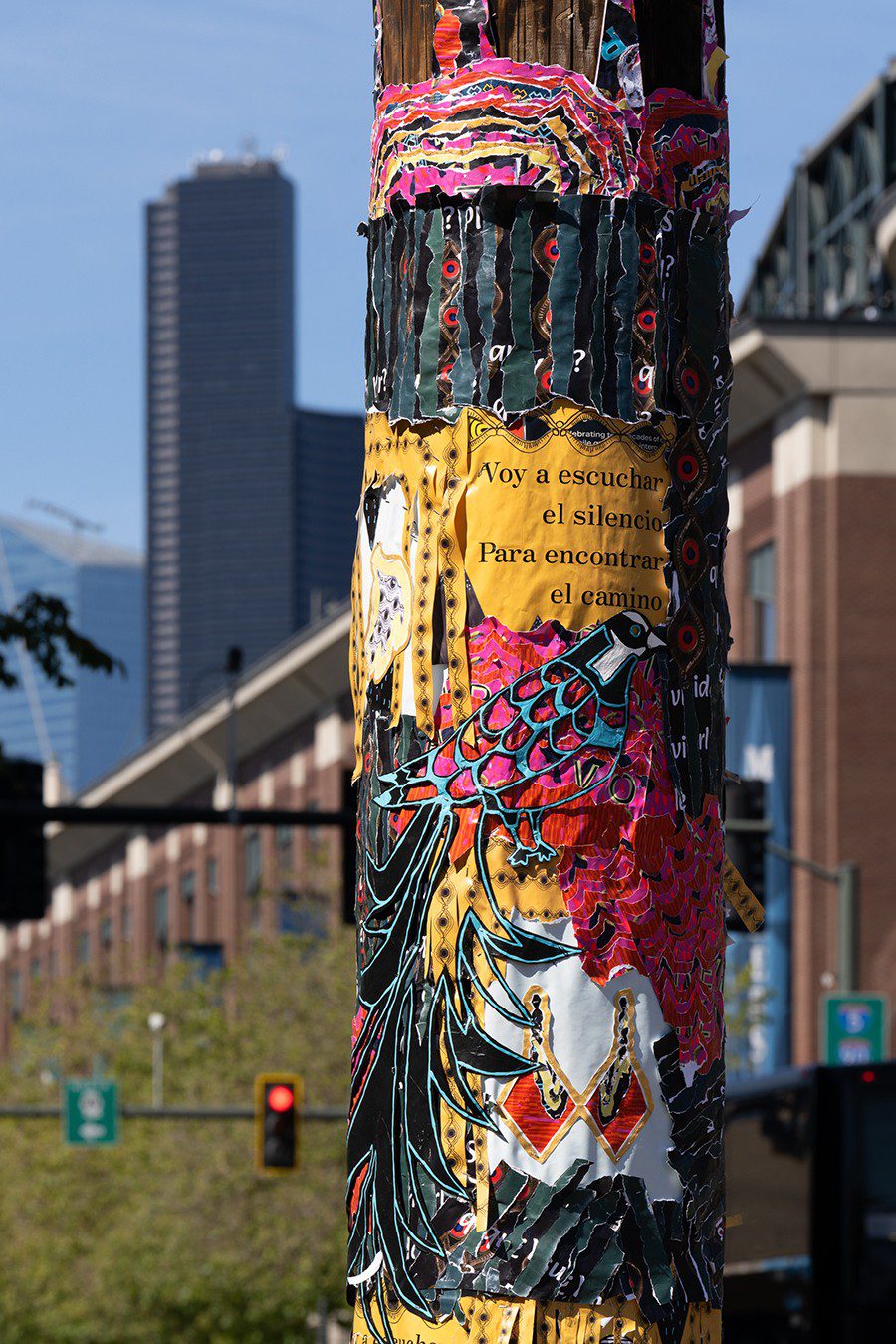
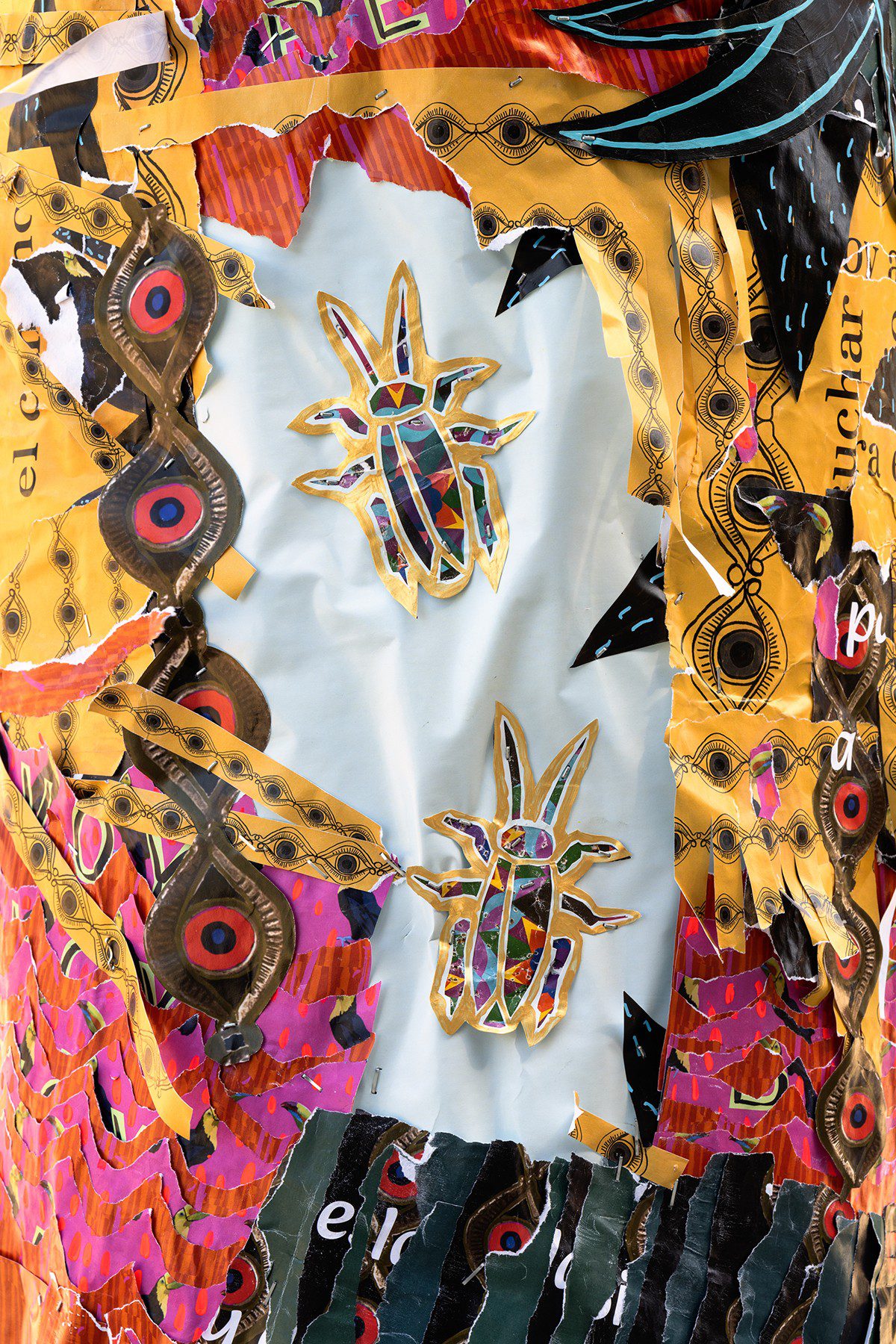
While visiting the poles recently, I saw a man walk past the Venezuela pole and then pause, turn around, and circle back to the pole. He stood there for a moment, touching the pieces of poster I had cut into strips so they would thrash around in the wind. Then he kept walking. I wonder what was going through his mind that caused him to turn around or to touch them. I imagine him doing a double take and getting drawn in by the colors and imagery, the text (even if he doesn’t understand Spanish), and the large cut-out quetzales (birds). I hope he and others experience a type of aliveness, of the fullness of being alive, including amidst great adversity. A kind of simultaneity that reflects what’s true about living life: familiar/unfamiliar, connection/separation, vitality/decay.
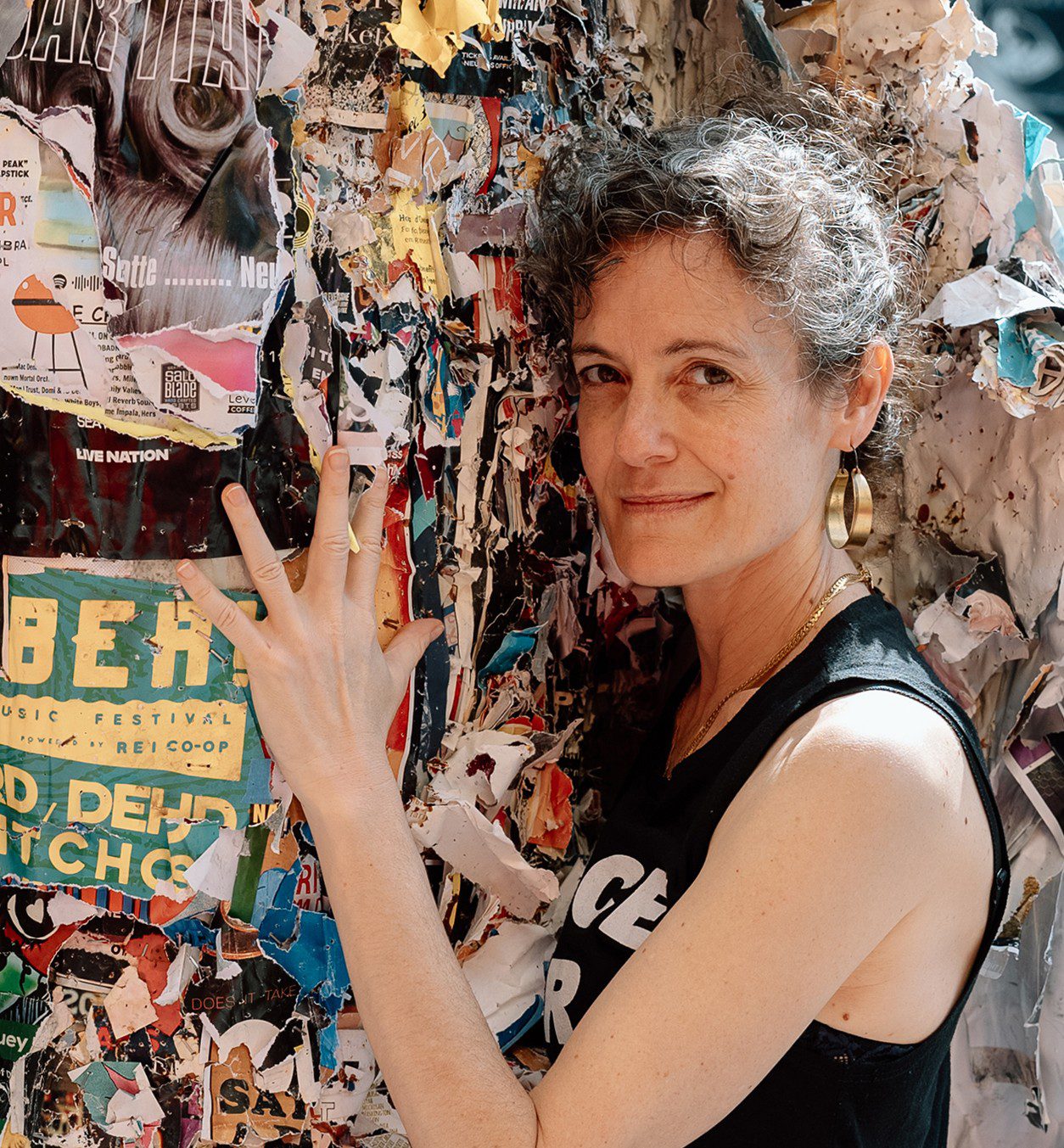
About Diana Dvora Falchuk
Diana Dvora Falchuk (she/ella) is a mother, artist, and facilitator of political and social change whose creative practices blend mediums and contexts to cultivate belonging, solidarity, and justice. Her work integrates mindful, embodied, spiritual, and ethical practices that allow us to notice and heal from patterns of separation and othering. Diana’s public and gallery-based artworks have included interventions on mailboxes and utility poles; installations, sculptures, and works on paper; videos, songs, and performances; and projects for direct actions. Falchuk has received awards and honors for her art and arts-integrated activism from Americans for the Arts, Artist Trust, the American Association of University Women, 4Culture, the City of Seattle Management Association, and City Arts Magazine. She holds a BA in English with a minor in Fine Arts from the University of Pennsylvania and a Master’s in Social Work from the University of Washington.