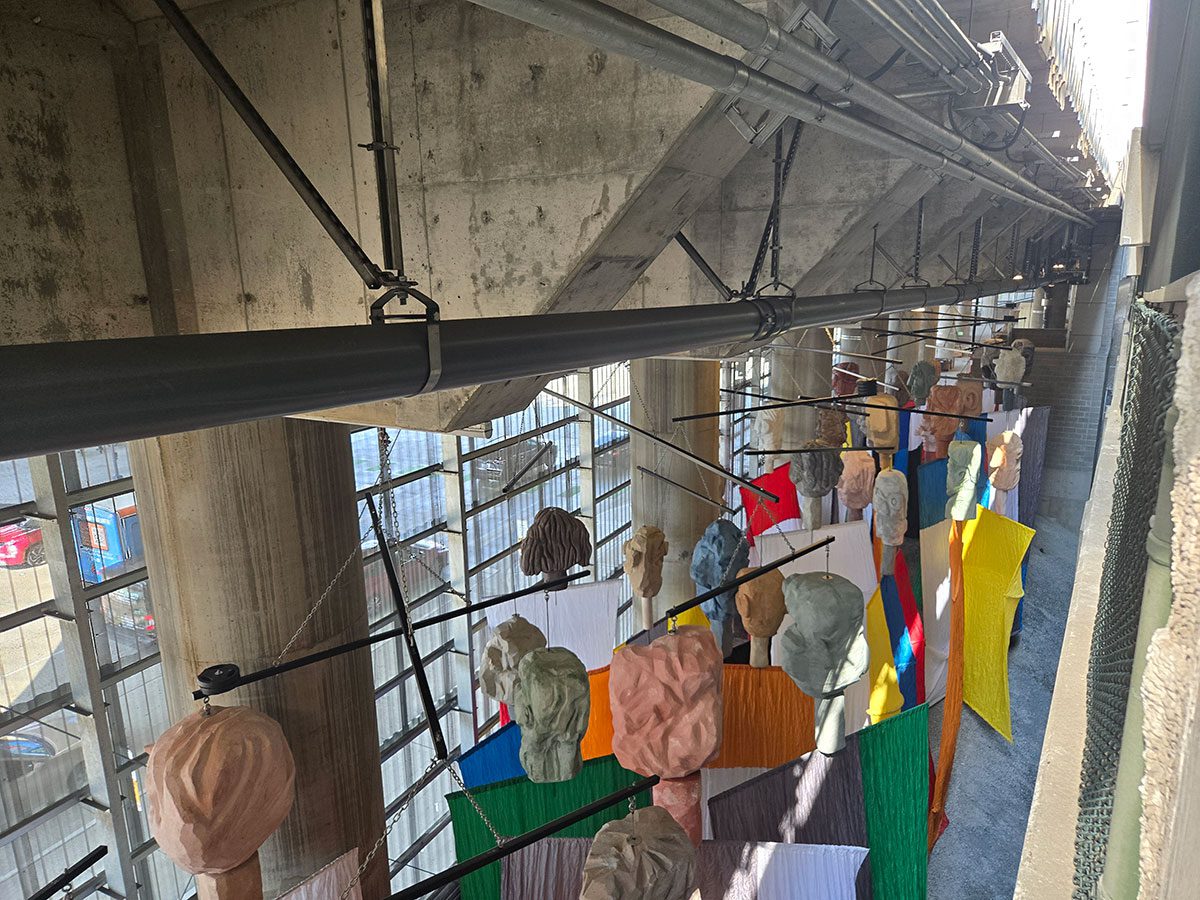
 A view down at the "Guests" during daytime. Photo by Office of the Waterfront.
 When Ann Hamilton presented the design for her project, Guests, she described the artwork as a “congregation of figures, of undulating cloth and cast shadows.” Indeed, that is what greets visitors through the perforated screen wall under Waterfront Park’s Overlook Walk. The artwork is under installation with an anticipated completion date (minus a few possible tweaks) of late August.
Originally selected in 2014 to work on public piers as part of the Waterfront Seattle program, Hamilton worked with staff at the Office of Arts & Culture to develop several proposals for different sites that ultimately proved unfeasible for the site or were demolished, like Pier 63. Under the guidance of the Office of the Waterfront and Civic Projects, the artist graciously agreed to propose a new project and selected an otherwise empty volume below the Overlook Walk. Described by Hamilton as a “non-site,” the location is a wedge-shaped space sandwiched between the Pike Place Market garage and the screen wall on the new Elliott Way and is animated by this public art project.

Forty-two large scale “puppets” – Hamilton has come to call gentle giants – now fully fill this space. Suspended from the underside of the pedestrian bridge and activated by air currents and the gentle assist of motorized cable, these larger-than-life figures will “float, bob and sway up and down” on mobile-like armatures. A series of unique heads, individually carved by the artist and her team in Columbus, Ohio, top bodies of bright, flowing “Spinnaker” cloth, aptly named for its use in this waterfront location. The artist collaborated with the Arts Tech Group, based in Renton, to develop the project and to sew and texture the cloth.
During the day, the project is visible from the street through the perforated screen wall and viewing ports installed at varying heights along the sidewalk side. The carvings and scale of each of the figures can be more closely viewed from the lower four levels of the Pike Place Market garage. At night, seen through the gridded scrim of perforated metal, the illuminated figures have the appearance of stained-glass while their lumbering floating suspensions make reference to the buoys and dynamics of water within their view.

The site which the sculptures occupy is described by Hamilton as having a “threshold nature” – it is neither interior nor exterior, it sits between land and water; the suspended sculptures themselves are both abstract and figurative. The billowing nature of the cloth evokes sails, semaphore flags, waves – elements of the marine environment. The cave-like space could be an underwater grotto. As daylight fades, and the custom-designed lighting brings this monumental artwork to life, a nocturnal puppet theater emerges. Viewers are invited to imagine that this crowd is alive and greeting visitors, both audience and performers in the theatre of the street.
Inhabiting a half-hidden cave-like space, Guests is a congregation of large-scale puppet-like figures who greet and witness the street, the water and the setting sun. Inspired by the subtle rising, falling and rocking motions of a buoy at sea, these landlocked figures lumber, drift and bob in response to the site’s fluctuations and tides of air and weight. Both audience and actors, animated as much by imagination as by air, theirs is not an unfolding narrative but an anticipation of tales yet to be told from the eternal turnings of the dark and the light, the visible and the invisible, the inside and the outside whose abstractions figure our stories.
– Ann Hamilton
We invite you to peek behind the screen and welcome the Guests.
This project is jointly administered by the Office of Arts & Culture and the Office of the Waterfront and Civic Projects and will enter the city’s Civic Art Collection.
Commissioned with Alaskan Way Seawall Bond 1% for Art funds.
About the Artist
Ann Hamilton has worked internationally since the mid-1980s, creating large-scale multimedia installations, collaborative performance and public projects in a variety of spaces. Her artworks respond to place and often include an accumulation of materials. Her honors include the National Medal of the Arts, Heinz Award, MacArthur Fellowship, United States Artists Fellowship, NEA Visual Arts Fellowship, Louis Comfort Tiffany Foundation Award, Skowhegan Medal for Sculpture, and the Guggenheim Memorial Fellowship and selection as the United States’ representative at the 1991 Sao Paulo Bienal and the 1999 Venice Biennale.
Significant projects include; Cortlandt Street Subway Station, New York (2018); Henry Art Gallery, Seattle (2014 and 1992); Park Avenue Armory (2013); The Pulitzer Foundation for the Arts, St. Louis (2010); The Guggenheim Museum, New York (2009); Contemporary Art Museum, Kumamoto, Japan (2006); La Maison Rouge Fondation de Antoine Galbert, Paris, France (2005); Historiska Museet, Stockholm, Sweden (2004); LEW wood floor, Seattle Central Library (2004); MASS MoCA, North Adams, Massachusetts (2003); The Hirshhorn Museum and Sculpture Garden, Washington D.C. (2003, 1991); The Wanas Foundation, Knislinge, Sweden (2002); Akira Ikeda Gallery, Taura, Japan (2001); The Musee d’art Contemporain, Lyon, France (1997); The Stedelijk Van Abbemuseum, Eindhoven, The Netherlands (1996); The Art Institute of Chicago (1995); The Museum of Modern Art, New York (1994); The Tate Gallery, Liverpool (1994); Dia Center for the Arts, New York (1993); The Museum of Contemporary Art, Los Angeles (1988).
Born in Lima, Ohio, Ann Hamilton received a BFA in textile design from the University of Kansas and an MFA in sculpture from the Yale School of Art. From 1985 to 1991, she taught on the faculty of the University of California at Santa Barbara. Hamilton served on the faculty of The Ohio State University from 2001 to 2023, where she was a Distinguished University Professor in the Department of Art.

This is a blog post from the Seattle Office of the Waterfront and Civic Projects.
Arts and culture play a central role on the waterfront. Responding to the history of the site, its ecology, economy and communities, publicly-sited art commissions help to create a sense of place that invite residents and visitors alike to visit the waterfront. Learn more about art in the Waterfront’s vision.
There are 9 publicly-sited artworks planned for the waterfront. Read our other posts about the completed pieces.